The Black Mass Export Ban: Why India Locked Down Its Battery Scrap
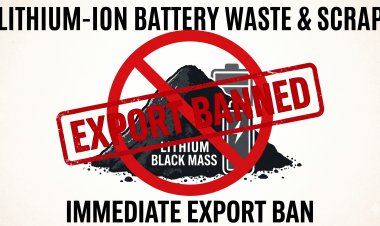
The Ministry of Commerce and Industry has issued Notification No. 49/2026-27, prohibiting the export of lithium-ion battery waste and scrap, commonly known as black mass, with immediate effect. This strategic pivot targets materials under ITC (HS) Code 8549 1400 to secure critical minerals for India's domestic EV supply chain. The ban reshapes the market by forcing a localized circular economy, presenting both significant scaling opportunities and new economic viability hurdles for domestic battery recyclers navigating the 2026–2031 market.
 Arvind Mohan
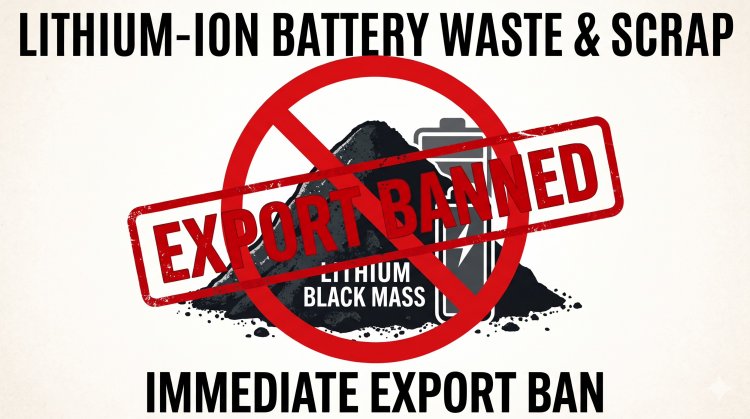
The Government of India has banned the export of specified lithium-ion battery waste and scrap—commonly known as "Black Mass"—with immediate effect. In a decisive move to secure the nation's domestic supply of critical minerals, the Directorate General of Foreign Trade (DGFT) issued Notification No. 49/2026-27 on November 10, 2026, abruptly halting the outflow of this highly valuable resource.
Here is a breakdown of the facts, the staggering numbers behind the decision, the economic reality for recyclers, and what this means for the global and domestic energy market.

The Facts of the Ban
-
The Policy Shift: The export policy for unsorted waste and scrap of primary cells, batteries, and electric accumulators (specifically those not containing lead, cadmium, or mercury) under ITC (HS) Code 8549 1400 has been officially amended.
-
Immediate Prohibition: Previously, this material could be exported freely. Now, the classification has been flipped from 'Free' to 'Prohibited' with immediate effect, and will remain so until further orders.
-
The Target Material: This ban explicitly targets "Black Mass"—the industry term for the mineral-rich, powder-like substance generated when spent lithium-ion batteries are crushed and shredded.

The Ground Reality for India's Top Recyclers
To understand why this ban was enacted, we must look at the current state of India's domestic recycling industry. The ecosystem is currently anchored by several key players, with the top 5 lithium scrap recyclers in the country including:
-
LOHUM Cleantech
-
Attero Recycling
-
BatX Energies
-
Exigo Recycling
-
Rubamin / Metastable Materials
Present Recycling Capacity vs. Raw Material Availability While these companies have aggressively expanded their infrastructure, there is a stark mismatch between their installed capacity and raw material availability. While India's total installed recycling capacity can handle upwards of 40,000 to 50,000 metric tonnes, the industry formally processes only about 19,000 tonnes currently.
Why the gap? Until this ban, a massive portion of premium end-of-life batteries and semi-processed black mass was either hoarded by the informal sector or exported to established refining hubs in East Asia. Domestic recyclers were starved of their own country's feedstock.
Are They Operating with Economic Viability? The short answer: It has been a severe struggle. Running a hydrometallurgical recycling plant requires massive fixed costs (CapEx). Because these top recyclers have been operating well below their peak capacity due to raw material shortages, their per-unit processing costs remained artificially high. Without adequate feedstock, achieving the necessary economies of scale is impossible.
This export ban is essentially an economic lifeline. By trapping the black mass domestically, the government guarantees a massive, steady supply of raw material. Once these recyclers can run their plants at 80% to 100% capacity, their fixed costs distribute efficiently, and the plants transition into high profitability.
What Elements Are Extracted from Black Mass? The viability of these plants relies on extracting and purifying highly valuable critical metals. Through advanced chemical processes, domestic recyclers extract:
-
Lithium (Li): Often recovered as lithium carbonate or lithium hydroxide.
-
Cobalt (Co): Highly valuable, recovered as cobalt sulfate.
-
Nickel (Ni): Recovered as nickel sulfate.
-
Manganese (Mn): Recovered as manganese sulfate.
-
Note: Graphite is also increasingly being recovered from black mass, while Copper and Aluminum are typically separated during the earlier mechanical shredding phase.
Economical Viability of Lithium Black Mass Recycling for a Recycler
From a recycler's perspective, the transition from merely shredding batteries to extracting high-purity metals is capital-intensive. As highlighted above, the economic viability of black mass recycling hinges entirely on economies of scale.
-
The CapEx Hurdle: Setting up advanced refining plants involves complex chemical leaching, solvent extraction, and purification processes that carry high fixed operating costs.
-
The Scale Imperative: At low volumes, the cost of chemical reagents, energy consumption, and strict environmental compliance outweighs the value of the recovered metals.
-
Profitability Realized: The revenue generated from selling localized, battery-grade active materials back to domestic cell manufacturers heavily outweighs the processing costs, but only if the plant has a continuous, high-volume feed of black mass.
The Scale of the Opportunity: Present vs. 2031 Projections
-
The 2031 Tsunami: Fast forward five years, and the landscape completely transforms. By 2031, formal lithium-ion recycling throughput is projected to surge to 80,000 tonnes annually.
-
Market Expansion: Driven by a robust Compound Annual Growth Rate (CAGR) of 19.5%, the domestic lithium-ion recycling market is expected to reach $138 million by 2031.
-
The Underlying Volume: Looking at the broader ecosystem, NITI Aayog projects that India will have a staggering 128 GWh of recyclable battery capacity by 2030, providing the exact volume needed for recyclers to maximize their economies of scale.
The Economic Rationale: Stopping the "Double Loss"
Historically, India has suffered a "double loss" in the battery supply chain. First, the country loses the outward value of exporting its black mass. Second, it absorbs the massive premium of importing refined, battery-grade cell components back from the countries that processed its waste. By choking off the export pipeline, the government is incubating a domestic refining industry.

Industry and Market Effects
This calculated pivot creates several immediate ripple effects across the sector:
-
Forcing Domestic Refining: Companies are being pushed to invest in full-cycle refining rather than basic shredding.
-
Meeting Strict EPR Mandates: The government’s Battery Waste Management Rules (BWMR) require material recovery targets to jump to 90% by 2026-2027. Furthermore, new EV batteries will be mandated to contain at least 5% recycled content by 2027-28, rising to 20% by 2030-31.
-
Slashing Import Bills: By recovering high-quality lithium, nickel, and cobalt from domestic waste, Indian battery makers can insulate the economy from volatile global commodity prices.
The era of freely exporting battery scrap is over. The critical challenge now is scaling domestic refining infrastructure fast enough to process the 80,000-tonne tidal wave of batteries headed our way in the next five years.